
Explore hands-on learning experiences led by experts through exclusive lab tours and field-based coastal studies.
About This Trip
Sites ~60 miles south of Houston along ~35 miles of the SE Texas coastline provide excellent locations to observe coastal sedimentological processes and their resultant deposits. This section of the Texas coast is characterized by barrier islands separated by tidal inlets and river outlets. The larger, sand-ridge cored, prograding Galveston Island contrasts with the smaller, wash-over dominated, retreating Follets Island and is separated by the stable, long-lived San Luis Pass that exhibits well developed flood and ebb tide delta systems. The Brazos River empties into the Gulf of Mexico to the south of Follets Island and forms a wave-dominated delta system. The Brazos River Delta has undergone significant changes due to human intervention and demonstrates the dynamic nature of sediment movement and deposition along the coast. This section of the coast provides insight into the steady lower energy background processes of sediment movement and the higher energy short term events, and the resultant reservoir characteristics of clastic coastal deposits from these different mechanisms. The understanding gained from these modern systems can be applied as an analog for subsurface characterization along the Gulf Coast and elsewhere.
Objectives
Understand clastic sediment distribution along coastal and barrier island systems.
What's Included
- Transportation
- Field Guide
- Lunch
Itinerary: (day by day details of the trip)
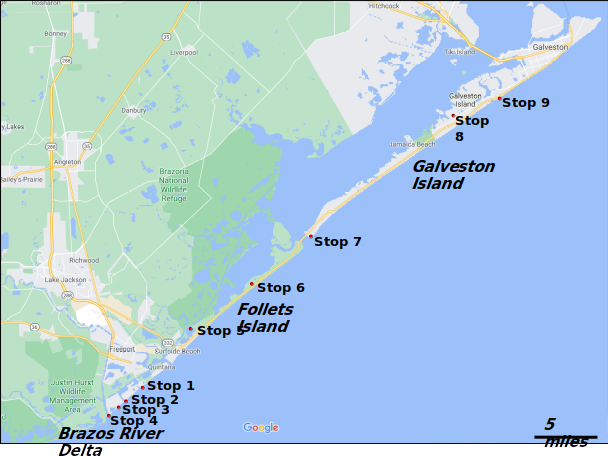
Stops 1 through 4 runs from Bryan Beach Park to the Brazos River Delta.
- Stop 1 – Overview of beach environments and processes
- Stop 2 – Recent erosion of back barrier deposits
- Stop 3 – Washover apron
- Stop 4 – Brazos River Delta
Lunch will be at the Brazos River Delta
Stops 5 and 6 are on Follets Island northeast of Surfside Beach
- Stop 5 (optional) – Back barrier environment
- Stop 6 – Washover fan system
Stops 7 to 9 are on Galveston Island from the San Luis Pass to the Galveston seawall
- Stop 7 – Tidal inlet and coastal dunes
- Stop 8 – Sand ridges
- Stop 9– Recent foreshore erosion/deposition
Return to Meeting Location
Trip Leaders:

Description (Course Content):
This field trip offers participants a tour of several cutting-edge research laboratories at Rice University. Visitors will explore:
- Multiphase flow microfluidic systems for studying fluid behavior in porous media, including visualizing CO2 migration and trapping via in-situ microscopy.
- CO2-foam experiments conducted at both microfluidic and core scales.
- Distributed fiber-optic sensing technologies (including DAS) for high-resolution seismic monitoring.
- Electrochemical approaches for key energy and sustainability applications, including electrochemical carbon capture and carbon conversion into valuable chemicals.
Objectives:
The objective of this field trip is to provide participants with firsthand exposure to advanced experimental techniques and research innovations in CCUS.
What's Included
- Lab safety glasses
- Break
- lunch
Itinerary:
Welcome remarks and introductions
Sahar Bakhshian’s lab tour
- (Microfluidic experiments of CO2 injection)
Jonathan Ajo-Franklin’s lab tour
- (Distributed fiber-optic sensing technologies)
Break
Lisa Biswal’s lab
- (CO2-foam experiments)
Haotian Wang’s lab
- (electrochemical carbon capture to carbon conversion)
Lunch
Trip Leaders:


- Field Trips are limited in size and reserved on a first-come, first-served basis and must be accompanied by full payment.
- If you do not plan to attend CCUS, a US$35 enrollment fee will be added to the field trip fee. This fee may be applied toward registration if you decide to attend the conference at a later date.
- A wait list is automatically created if a field trip sells out. You will be notified if space becomes available.
- It is recommended that you register before 24 February. At this time, it may be determined if the field trips will be cancelled due to low enrollment.
- Before purchasing non-refundable airline tickets, confirm that the trip will take place, as trips may be cancelled if undersubscribed.
- We will continue to take registrations for field trips not cancelled until they are either sold out or closed.
- Cancellations can be made by contacting CCUS Registration on or before 6 March 2026.
- Cancellations received on or before 6 March 2026 will receive a refund less a US$75 processing fee.
- Refunds will not be issued after 6 March 2026 or for “no shows.”
- You may substitute one participant for another.